
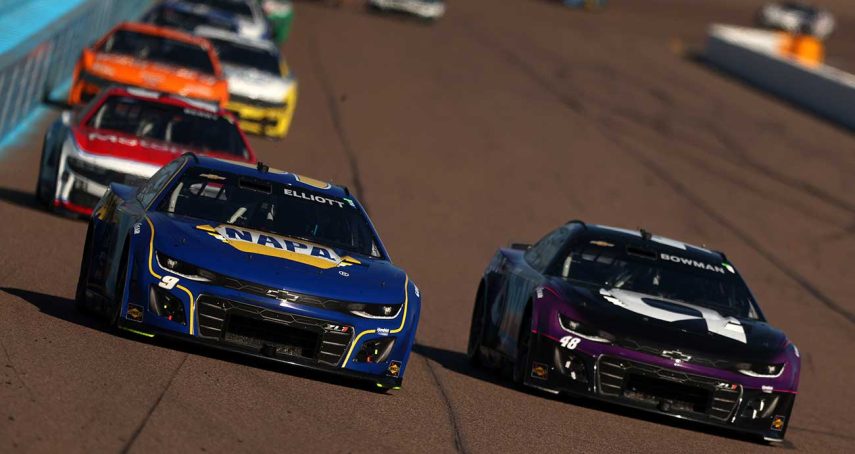
After scraping into the NASCAR Playoffs last year, Alex Bowman joked that he owed fellow driver Ryan Blaney “seven million beers” for winning the regular-season finale and preventing a potential new winner from taking his place on the postseason grid. With a new season just a handful of weeks away, Bowman admitted that he hasn’t settled up. “I didn’t. Yeah, I guess I still owe him seven million beers,” Bowman said Thursday. “I don’t know that I can afford seven million beers, though. I mean, the beer would be bad by the time you got through.” The method for how Bowman clawed his way into the 2025 postseason, however, is out – and any potential seven-figure beer pledges that go with it might be shelved, too. The dynamics that used to determine the Cup Series’ championship-eligible field have been replaced by a consistency-heavy 10-race Chase format, and Bowman believes his No. 48 Hendrick Motorsports Chevrolet team – retooled for the 2026 campaign – should profit. “I think on paper every year, it would have benefited us,” Bowman said. “So yeah, I think it’s definitely good for me, but yeah, we’ll have to wait and see. Like I said, it probably fits us a little bit better than the other style, but at the same time, it’s just hard to see how the season plays out.” The overall outlook for the upcoming season appears bright for the Rick Hendrick-owned organization, with defending champion Kyle Larson alongside Bowman, former champ Chase Elliott and two-time defending Daytona 500 winner William Byron in the fold. All four met the media Thursday afternoon from the Papa Joe Hendrick Meeting Center room in the gleaming new Atrium Health Motorsports Athletic Center, which represents a next-level leap in team and pit-crew performance and wellness on the Hendrick Motorsports campus.
It’s an ever farther step ahead of the norm that Rick Hendrick recollects from when he started this operation in 1984, when over-the-wall crew members were just regular guys from the shop — “big tummies, smoking cigarettes,” he said to laughs. A decade later, Hall of Famer Ray Evernham revolutionized pit-stop performance through athletic training, but even then, the methods were primitive, with wind sprints in the shop’s surrounding fields and hills a primary form of exercise early on. Evernham was there Thursday to witness Hendrick and Atrium Health officials cut the ribbon to officially open the state-of-the-art, 35,000-square-foot facility, in the former chassis shop adjacent to the team’s museum. “Heck, five years ago I don’t know if I could have envisioned this, you know?” said Hendrick Motorsports vice chairman Jeff Gordon, who won three of his four Cup Series championships with Evernham as his forward-thinking crew chief. “I mean this is taking it to a whole ‘nother level, but the amount of attention that we’re putting into our athletes and just seeing our coaches and their recruiting process, that’s been going on for eight to 10 years, and so I’ve seen how that’s been evolving, and you see how the pit stops are becoming more and more important. Those results are really the difference-maker in a lot of races and championships.” The other difference-making factor may well be the first new NASCAR championship structure in 13 years. Just last season, the now-shuttered elimination playoff system presented Hendrick Motorsports with fates that touched both ends of the spectrum. At one end was Larson, whose fire suit now shows him as a two-time Cup Series champion after his surprising vault past a dominant Denny Hamlin in the final laps of the season in the winner-take-all finale at Phoenix Raceway. On the other side was Bowman, who was a respectable ninth in the Cup Series standings heading into last year’s regular-season finale. Because of the crowd of winners who reached the playoffs from below the playoff standings’ elimination line by the “win-and-in” rule, the No. 48 driver’s consistent-but-winless stature placed him on the razor’s edge of qualifying for the 16-driver field. “But under this format, he would have been in far more easily. We were going through that because of the win and you’re in,” Gordon adeptly noted, speaking from experience as a driver who competed under each recent evolution of the championship procedures. The return to a revised Chase system, he said, was a welcome adjustment with positive trade-offs – both for his team and the NASCAR industry at large. “I think that when I look through the history, and I look at what’s the biggest, best compromise to 36 races with points accumulation versus a one-race championship win in Phoenix to decide the championship, 10 races, I think, is the right way to go,” Gordon said. “I mean, I got to experience the Chase myself, and all I had ever asked for in that is just switching up the tracks, whether it’s the lineup of the tracks or just changing up the last race or the handful of races, and so I do hope that that’s a part of this as we move forward. But from a Hendrick Motorsports standpoint, I think consistency is something that works for us very well. I think our drivers and teams are going to thrive in that, but I also think it legitimizes it a little bit more. I mean, I don’t want to take away from anybody that’s won a championship under this most recent format, but to come down to one race, you can have what we just had happen, right? It can go one way or another for you, and I think to be able to do that over 10 races, I think it’s going to really show who the best team is for the seaso