
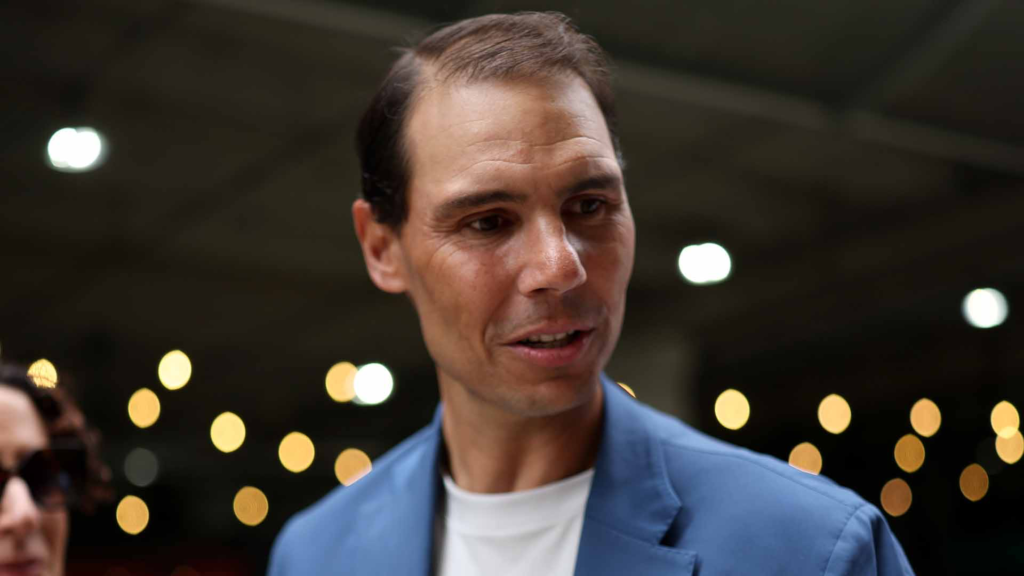
Rafael Nadal recently visited a whole lifetime in the new museum at the Rafa Nadal Academy.
The Spaniard’s beginnings in Manacor, his first racquets, photos of him as a child, the great venues, the trophies, the rivals, the impossible nights, the seemingly endless days, and the victories that defined one of the most important careers in sporting history. It’s all there. Organised, illuminated, converted into memories.
But when Nadal walks through that past, he does not do so with the nostalgia of someone who wishes he could go back. Nor with the melancholy of someone who feels something was left unfinished. He does so as someone who knows a chapter had to end simply because the time had come.
“I’m lucky that it’s a closed chapter, well and truly closed,” he explained during the official opening of the new museum at the Rafa Nadal Academy.
Nadal’s answer was as direct as it was revealing. There’s no daily longing. There’s no need to relive the past. There’s no unfinished conversation with the player he used to be.
“Luckily, I think I reached the limit of my abilities. I don’t think mentally, but physically, yes,” admitted Nadal, who spoke openly about that final stretch of his career, which was defined by injury, surgery and recovery.
For a long time, Nadal fought against his own body with the same rule he applied throughout his sporting life; try until the very end. Not because he needed a perfect farewell. Not because he wanted one last big triumph. Not because his ego demanded he leave with a trophy held high. He did it because he was still finding joy on court.
“I was happy doing what I did. The reality is I was still competitive and, quite simply, I still enjoyed what I was doing,” Nadal, the former No. 1 player in the PIF ATP Rankings, explained.
This is perhaps the best summary of his swansong. Nadal didn’t hang his racquet up because he’d stopped loving tennis. He did so because he understood that his body would no longer allow him to experience it in the way he needed to. Which is why, having exhausted every available option, he appears to be in a place of absolute peace.
“I did what I needed to do to give myself a chance to continue,” Nadal recalled.
The 22-time major champion acknowledged that the operation he underwent came with a promise; there would be a genuine chance to compete at the highest level again. Given that hope, Nadal chose the toughest road. Months of hard work, pain, uncertainty, and a recovery that, in hindsight, perhaps he would not have undertaken had he known the outcome.
“Knowing what came afterwards, I wouldn’t have done it,” he admitted. “But they gave me confidence that with an operation there’d be a chance to compete again, so I did it.”
It was not a decision made out of an obsession to prolong his career. It was, in fact, the most coherent way to end it. Nadal needed to know he’d left no stone unturned. That if the end came, it would come having explored every reasonable possibility. That he would never be left wondering.
“If I hadn’t tried, maybe I would be here now, looking at the pictures in the museum, or those that sometimes come up on TV, thinking ‘maybe I should have given it a go,’” he said.
But that thought does not exist. And that is, perhaps, the greatest personal victory of his retirement. Nadal now looks back at his career as something that forms part of his life, but no longer rules his present. He views it with gratitude, with pride, even with emotion on special days like this, but not with dependence.
“Honestly, today I can say no, I don’t miss it because I know that’s no longer my place,” he affirmed. “That chapter is well and truly closed. I have great memories of it, but I don’t live with those memories every day, I say that with total honesty. I’m in a new stage of my life and I’m enjoying it.”
The museum’s opening inevitably unearthed numerous pictures. Some of Nadal the child. Others of the champion who never stopped winning at Roland Garros, of the competitor whose Lexus ATP Head2Head rivalries with Roger Federer and Novak Djokovic reached historic heights, and of the player who turned determination, resilience and the ability to suffer into an art form.
However, Nadal has never been particularly fond of self-reflection. Not before, and not now.
“At home, I’m not one for admiring myself, I never have been, and even less so now,” he explained. “When I see the images, on days like today, they bring back lovely memories.”
That sense of distance was also evident when he was asked if the end of his career had been painful, given the magnitude of everything that preceded it. If, with the benefit of hindsight, it would have been better to finish at the top, for example after winning Roland Garros in 2022.
Nadal didn’t dodge the question. On the contrary, he provided a very personal response.
“That’s only something people with a big ego need. Honestly, that’s not the case with me,” he replied. “I think what I did is what I am as a person, which is to try till the very end.”
Then came an important nuance. If he’d known all the physical suffering that would follow, he would have retired earlier. But not for the legacy. Not for the story. Not to go out on a win. He would have done it to avoid a process of pain that ended up being much tougher than expected.
“I would have retired, but for one simple reason; I went through an operation, I went through many months of recovery in pain. A year of pain to try to recover,” he explained.
Sport is often seen through the lens of epic comebacks, the possibility of one last great night, the temptation to imagine perfect endings. Behind the curtains though, Nadal reminds us, things are much more complicated.
“From the outside we all have opinions on all sports based on what we see as simple spectators, which is normal. But we don’t know what’s really happening on the inside,” he said.
You May Also Like: Nadal opens new museum ‘Inside the Legend’ that explores his life on & off the court
What was happening behind the scenes was that Nadal believed he could come back. That three weeks after winning Roland Garros in 2022 he felt ready to fight for Wimbledon. That his body broke down again while his enthusiasm was yet to wane. That injuries gradually took away his options until there were none left.
“Why would I retire after winning Roland Garros if I’m happy doing what I do? If, really, three weeks later I thought I was ready to win Wimbledon,” he recalled. “I tore my abdominal muscle, unfortunately, in the quarter-finals. Afterwards, life dealt me more injuries, but I have absolutely no regrets about carrying on.”
The museum houses trophies, photos and objects. There’s sporting memory. There’s a visual journey through the Nadal of yesteryear. But perhaps the most significant thing is that which is unseen; the peace with which he accepts the fact that that version of him is no longer here.
“I think I finished just as I am, as a person,” he concluded.
And that phrase, on a day replete with memories, explains better than any other why Nadal can walk through his own museum and leave without looking over his shoulder.