
As we gear up for Roland-Garros 2026, let’s take a look back at the tournament’s anniversary editions.
THURSDAY 30 APRIL 2026 – RÉMI BOURRIERES
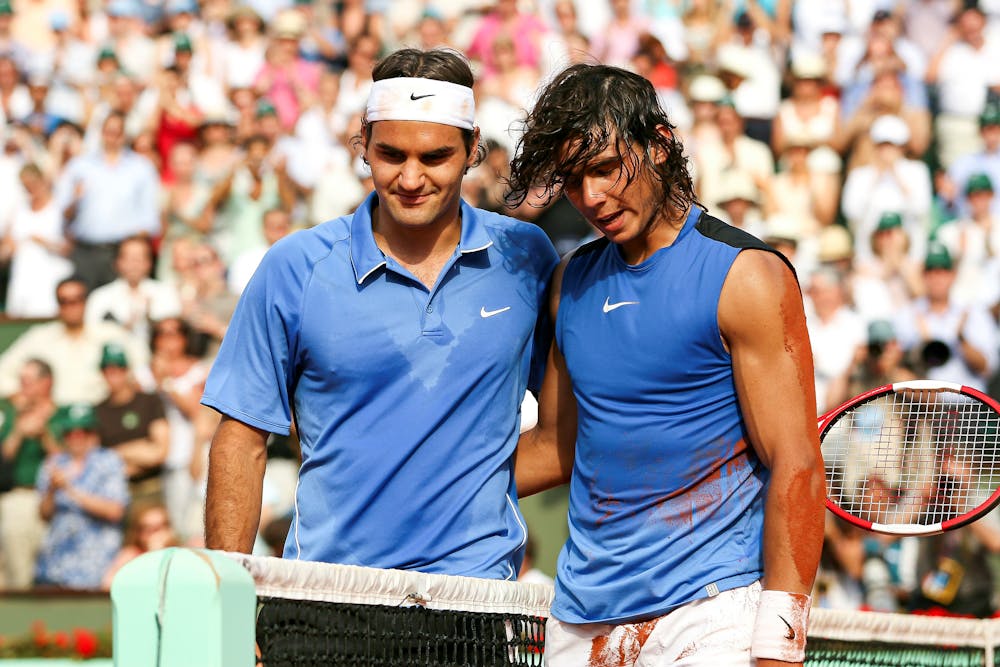
Twenty years ago, the 2006 edition of Roland-Garros played host to the very first Grand Slam final between Roger Federer and Rafael Nadal. On the road to the title, Rafael Nadal also played Novak Djokovic for the first time in what would become a long-shared history.
FEDERER VS. NADAL, CLASH OF THE TENNIS TITANS
In 2006, the on-court rivalry between Rafael Nadal and Roger Federer was already well established, but it was missing a Grand Slam final in order to become truly legendary. Roland-Garros had the privilege of being the clay-court theatre for this first clash of the titans. Even before the first point was played, the encounter was considered historic, as the last Parisian final featuring both the World No.1 (Federer) and World No.2 (Nadal) was back in 1984, when John McEnroe lost to Ivan Lendl.
A year earlier, Rafa had begun his long reign on clay, and his 2006 campaign read like a preface to his future adventures. In the first round, he played Sweden’s Robin Söderling, who would become the first player to defeat King Nadal at the Porte d’Auteuil three years later. On this occasion, Nadal beat the Swede in straight sets (6-2 7-5 6-1) to clinch his 54th consecutive victory on clay, breaking Guillermo Vilas’ record (the Spaniard took the record to 81 the following year).
Nadal’s win against lucky loser Kevin Kim in the second round was also memorable, not for the match’s result (6-2 6-1 6-4), but for the American’s famous post-match comment: “[Playing Nadal on clay] felt like you’re in the Sahara and you just see the hills, and there’s no ending.” That said, the rest of the tournament was full of ups and downs for the Majorcan, who had to survive a Herculean third-round match against France’s current Davis Cup captain, Paul-Henri Mathieu (5-7 6-4 6-4 6-4). He dropped another set against Lleyton Hewitt in the Round of 16 (6-2 5-7 6-4 6-2), then beat the FFT’s future director of high-performance tennis, Ivan Ljubicic, in the semi-finals (6-4 6-2 7-6).
Roland-Garros 2006 was the first major event to feature the Big 3, though they were not yet known as such. In the quarter-finals, Nadal came up against a young man he had never played before: a certain Novak Djokovic who, at age 19, was playing for the first time at this level in a Grand Slam. Forced to retire after losing the first two sets (6-4 6-4 ret.), the Serb made everyone smile in his post-match press conference, when he claimed that he had felt he was “in control of the match” before injuring his back. The statement seemed presumptuous at the time, but it said a lot about the champion he would later become
For Nadal, however, the most difficult challenge still lay ahead: defeating the man who was already standing out to be his main rival, Roger Federer, in the final. The Swiss maestro had won the last three Grand Slam tournaments and was eager to make it four in a row. Nobody was able to match his skill on court, except for the indomitable Spaniard, who had won five of their six matches, three of which were in 2006, including the finals in Monte-Carlo and Rome. In Italy, the spectators were treated to a thrilling encounter – the longest ever “Fedal” match to this day (5 hours 5 minutes) – during which Federer failed to convert two championship points.
In Paris, the World No.1 had good reason to believe he could win the title, having never before lost in the final of a Major. He sailed through the first set, taking a 6-1 lead over his uncharacteristically apathetic opponent. But the match turned at a seemingly insignificant moment, in the second game of the second set when, despite racing to a 40-0 lead, the Swiss lost his service game by committing three errors, including a gift of a volley that he hit straight into the net. This lapse in concentration proved costly.
Suddenly, Rafa stepped back into Nadal mode. He pounced on his prey and took control of the match, though not without faltering one last time: up 5-4, 30-15 on his serve in the fourth set, the Majorcan was broken by Federer who, with nothing left to lose, put everything on the line to hold off the inevitable. It was a nice try, but the man from Manacor tightened his grip in the tiebreak, putting the finishing touch to his masterpiece with a superb cross-court topspin forehand volley. At age 20, Rafael Nadal clinched his second Roland-Garros title, continuing his unbeaten run on clay.
The 2006 edition of Roland-Garros was groundbreaking in many ways, as it also marked the introduction of the “Sunday Start”, a new feature in the Grand Slams. It was the year that 19-year-old Andy Murray made his Parisian debut, suffering a five-set defeat in the first round at the hands of an equally young Gaël Monfils. The Frenchman’s luck continued until the Round of 16, where he was defeated by Djokovic. The tournament heralded much promise for the future, but in the end, as always, it was Rafael Nadal who came out on top.