
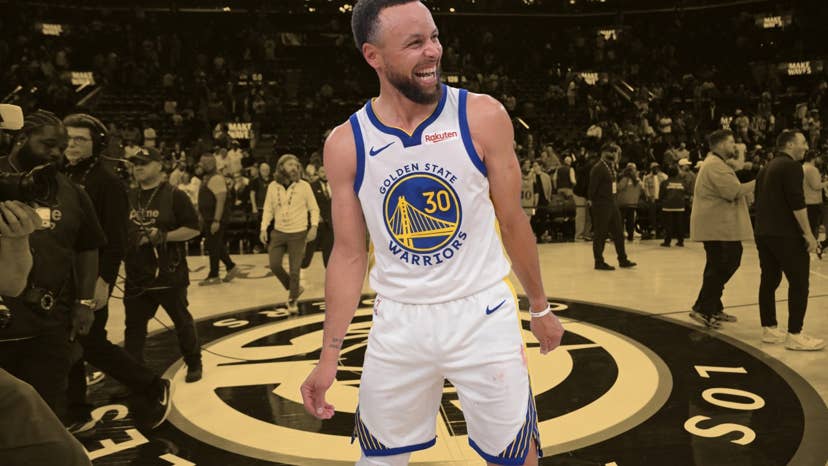
The Western Conference isn’t waiting around for the Golden State Warriors to figure things out. Most teams in the conference enter the 2026-27 season with legitimate playoff ambitions, while Oklahoma City and San Antonio already look built to control the conference for years.
Rather than looking like a team eager to bounce back after failing to make the playoffs last season, Dubs are looking increasingly difficult to define. The roster is filled with aging stars, an inexperienced supporting cast and injury-prone players, making them one of the least intimidating teams on paper.
Thus, at this point, simply being in the postseason could be a more than challenging ask for the Dubs. And Ric Bucher has little patience for those Warriors fans who believe having Stephen Curry motivated and healthy is going to get them over the time.
n fact, Bucher believes that the two-time MVP is hurting, rather than helping, the franchise with his massive paycheck.
“Delusional Warriors fans fervently hold onto the notion that as long as Curry is healthy, the Warriors have a chance of winning another ring,” Bucher said.
Bucher drops some harsh facts
The Warriors’ situation is a perfect example of how difficult it can become for an aging roster to remain competitive under the NBA’s current financial system.
Under the current CBA, the league no longer operates with a single hard salary cap line. Instead, franchises face multiple financial thresholds, with increasingly restrictive penalties once they move beyond each one.
For instance, for the 2026-27 season, the salary cap is roughly $165 million, while the luxury tax threshold sits around $200 million. Above that are the first apron at roughly $209 million and the second apron at approximately $222 million.
Now, crossing those thresholds gradually reduces a team’s flexibility.
Teams above the first apron lose access to the full mid-level exception and face restrictions on how much salary they can take back in trades. Going beyond the second apron becomes even more restrictive, with teams unable to use exceptions, send cash in trades, or aggregate multiple players’ salaries in a trade.
Clearly, such a harsh system was designed, in part, to make it increasingly difficult for teams to maintain an expensive veteran core indefinitely and absorb the financial consequences.
And this is where Steph’s contract is clearly affecting the Warriors.
His league-high salary of $62.6 million accounts for roughly 38 percent of the Warriors’ salary cap on its own. Jimmy Butler’s $56.8 million salary and they account for approximately $119 million, which is nearly a third of the cap.
And this Bucher made it clear how Curry is unknowingly making it impossible for Golden State to compete.
“Steph has been the highest-paid player before on a team that did not make the postseason. Steph led the league in scoring that year; he was third in MVP voting. The possibility of either of those things happening in the next three is extremely remote,” Bucher added. “Steph’s salary is certainly going to limit what the team is capable of putting around him.”